 Galaxies
Dark Matter: The Invisible Architect of Galaxies
It makes up roughly 85 percent of all matter in the universe. It holds galaxies together, bends the path of light, and shaped the cosmic web of structure we see today. Yet despite decades of searching, nobody has ever directly detected a single particle of dark matter. This is the story of the universe's greatest invisible component — and the worldwide effort to finally pin it down.
The Evidence: Why We Know Dark Matter Exists
The first clues emerged in the 1930s when Swiss astronomer Fritz Zwicky studied the Coma Cluster of galaxies. He measured the velocities of individual galaxies within the cluster and found they were moving far too fast to be gravitationally bound by the visible mass alone. Zwicky calculated that the cluster needed roughly 400 times more mass than what was visible to hold itself together. He called this hidden mass "dunkle Materie" — dark matter.
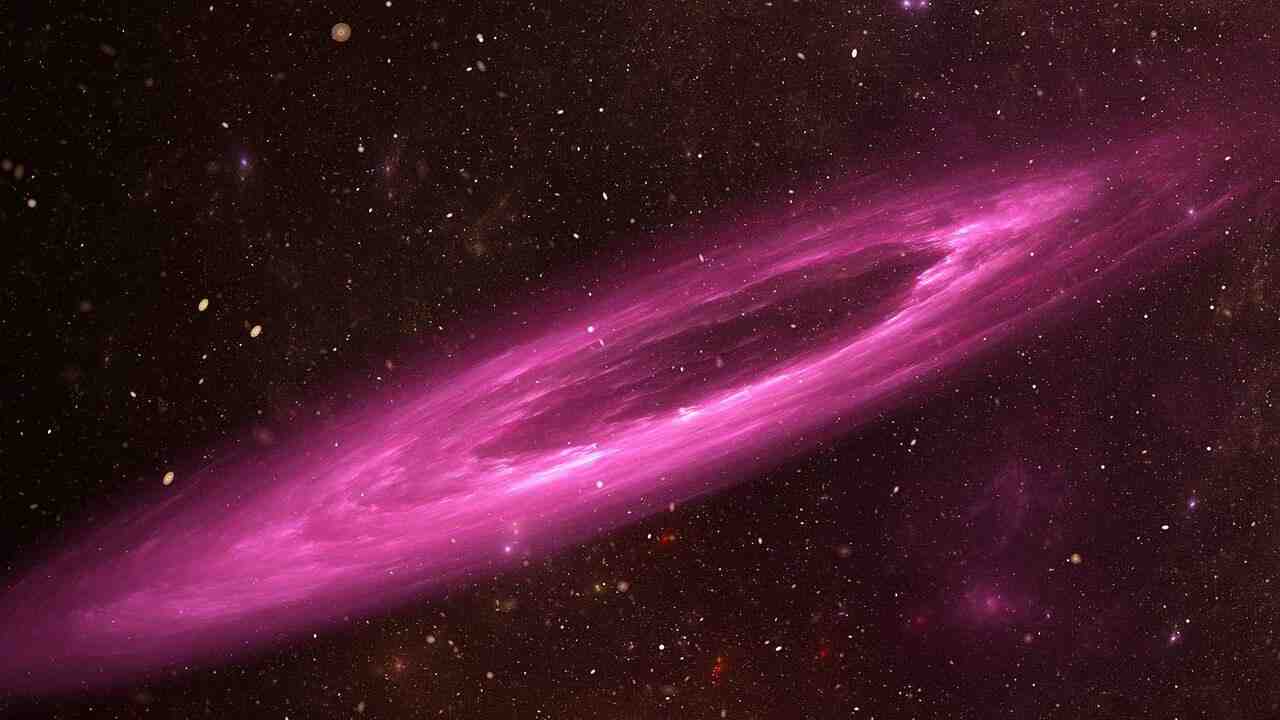
The case grew stronger in the 1970s when Vera Rubin and Kent Ford mapped the rotation curves of spiral galaxies. According to Newtonian dynamics, stars farther from the galactic center should orbit more slowly — just as Pluto moves more slowly around the Sun than Mercury does. Instead, Rubin found that stars at the outskirts of galaxies orbit just as fast as those near the center. The only explanation: galaxies are embedded in enormous halos of invisible mass extending far beyond their visible disks. Without this dark matter halo, spiral galaxies would fly apart.
Perhaps the most visually compelling evidence comes from the Bullet Cluster — a cosmic collision between two galaxy clusters observed in 2006. When the clusters collided, the hot gas (visible in X-rays) slowed down due to electromagnetic interactions, while the dark matter (mapped via gravitational lensing) passed right through unimpeded. The separation of normal matter from the gravitational mass is unmistakable and extremely difficult to explain without dark matter.
The cosmic microwave background — the afterglow of the Big Bang — provides the most precise measurement. The Planck satellite's map of tiny temperature fluctuations reveals a universe composed of roughly 5 percent ordinary matter, 27 percent dark matter, and 68 percent dark energy. The pattern of these fluctuations would look completely different without dark matter's gravitational influence in the early universe.
What Dark Matter Is NOT
After decades of elimination, we know what dark matter cannot be. It is not ordinary baryonic matter in the form of dim stars, planets, or gas clouds — the CMB data and Big Bang nucleosynthesis calculations rule this out definitively. It is not neutrinos from the Standard Model, which are too light and too fast to clump into galaxy halos. It is not black holes in the typical mass ranges, which would produce detectable microlensing signatures that surveys have constrained to negligible levels.
Dark matter must be cold — meaning it moves slowly compared to the speed of light — to allow structures like galaxies to form through gravitational collapse. It must interact primarily through gravity, with at most extremely weak interactions via the other fundamental forces. And it must be stable, or at least long-lived, to still exist today 13.8 billion years after the Big Bang.
WIMPs and the Search Underground
For decades, the leading candidate was the WIMP — the Weakly Interacting Massive Particle. Predicted by supersymmetry theories, WIMPs would have masses between 10 and 1000 times that of a proton and would occasionally interact with ordinary matter through the weak nuclear force. The "WIMP miracle" — the fact that particles with weak-scale interactions would naturally produce the correct dark matter abundance through thermal freeze-out in the early universe — made this idea incredibly compelling.
The search for WIMPs has driven some of the most sensitive experiments ever built. The LZ (LUX-ZEPLIN) experiment in South Dakota uses 7 tonnes of liquid xenon buried a mile underground, watching for the tiny flash of light and ionization that a WIMP collision would produce. XENONnT in Italy's Gran Sasso laboratory pursues the same goal with similar technology. The PandaX experiment in China and the DarkSide experiment using liquid argon round out the global effort. So far, none have found a definitive signal — pushing the possible WIMP interaction cross sections to ever-smaller values.
Axions: The Dark Horse Candidate
As WIMP searches come up empty, attention has shifted to another compelling candidate: the axion. Originally proposed in 1977 to solve a problem in the strong nuclear force called the "strong CP problem," axions would be extremely light — trillions of times lighter than an electron — and would interact even more feebly than WIMPs. Yet they could be produced in enormous numbers in the early universe, forming a cold, Bose-Einstein condensate-like dark matter halo.
The Axion Dark Matter Experiment (ADMX) at the University of Washington searches for axions by looking for their conversion into microwave photons inside a strong magnetic field — a process predicted by the axion's coupling to electromagnetism. The experiment uses a tunable resonant cavity chilled to near absolute zero, slowly scanning across possible axion masses. Other experiments like CAST at CERN search for axions produced in the Sun, while laboratory experiments like ALPS II probe axion-like particles using powerful lasers and magnetic fields.
Alternative Theories: MOND and Modified Gravity
A stubborn minority of physicists argues that we may not need dark matter at all — that our theory of gravity itself needs modification. Modified Newtonian Dynamics (MOND), first proposed by Mordehai Milgrom in 1983, modifies Newton's laws at extremely low accelerations to reproduce galaxy rotation curves without dark matter. While MOND works remarkably well for individual galaxies, it struggles to explain cluster dynamics and the Bullet Cluster, and it lacks a consistent relativistic generalization that matches cosmological observations. Most cosmologists view it as an interesting phenomenological fit rather than a fundamental theory, though variants like TeVeS and emergent gravity continue to be explored.
Current Experiments and The Future
The next five years represent a critical period for dark matter research. LZ and XENONnT will continue to push WIMP sensitivity into new territory, approaching the so-called "neutrino floor" where coherent neutrino scattering becomes a background that cannot be shielded. ADMX and its successors will scan broader ranges of axion parameter space. The Vera C. Rubin Observatory's Legacy Survey of Space and Time (LSST) will map the distribution of dark matter through weak gravitational lensing with unprecedented precision, potentially revealing new clues about its particle nature.
A detection could come from any of these directions — or from a completely unexpected one, such as the James Webb Space Telescope observing anomalous structures in the early universe that challenge our dark matter models. The Large Hadron Collider continues to search for dark matter production in high-energy proton collisions, where missing energy signatures could betray the creation of invisible particles.
"The universe is not only queerer than we suppose, but queerer than we can suppose." — J.B.S. Haldane. Dark matter embodies this sentiment perfectly: the dominant form of matter in the cosmos may be something entirely outside our current Standard Model of particle physics.
Conclusion
Dark matter remains one of the most profound mysteries in modern physics. The evidence for its existence — from galaxy rotation curves to the cosmic microwave background — is overwhelming, yet its fundamental nature remains elusive. Whether it is WIMPs, axions, or something even stranger, the answer will likely rewrite our understanding of particle physics and cosmology. The invisible architect of the cosmos is still hiding — but with each new experiment and observation, we draw closer to revealing its true identity.